
Slinger Banksman Safety Training
We train personnel to safely attach, signal, guide and control lifting operations. The course covers lifting accessories, sling angles, load weight, centre of gravity, lift plans, radio communication, hand signals, documentation, certification and proximity hazards.
- Home
- Lq-project
- Slinger Banksman

Slinger Banksman Safety Training
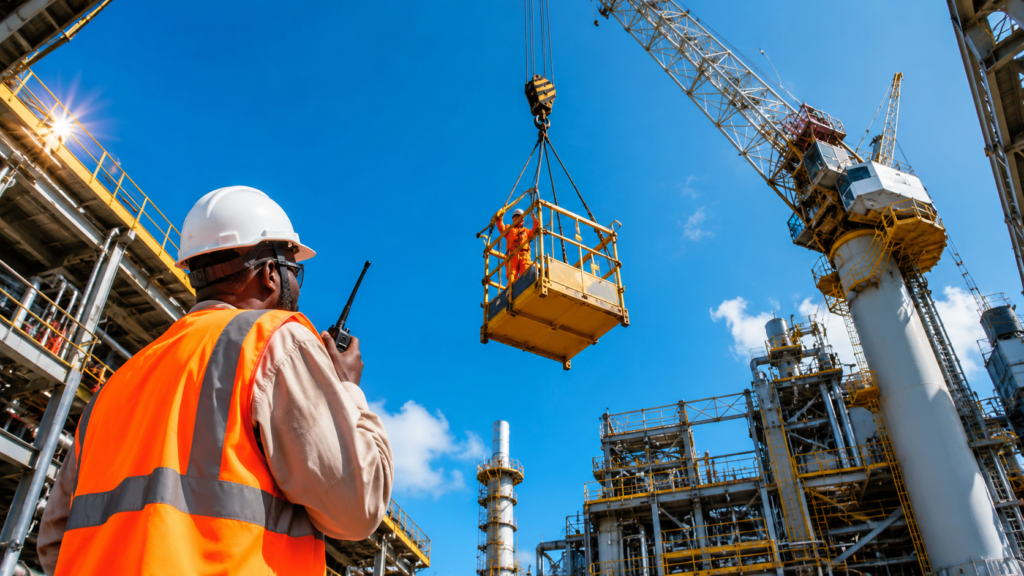
TechInspecta provides Banksman & Slinging Safety Training for workers, riggers, slingers, banksmen, signalers, crane assistants, supervisors, lifting teams, contractors and industrial personnel involved in lifting operations.
This training is designed for workers who are responsible for attaching loads, selecting lifting accessories, guiding crane operators, controlling load movement and ensuring safe communication during lifting activities. In industries such as oil & gas, construction, ports, mining, manufacturing and offshore operations, the role of the Slinger Banksman is critical to preventing dropped loads, equipment damage, injuries and fatal accidents.
Lifting operations must be properly planned by a competent person, appropriately supervised and carried out safely. International guidance such as LOLER also requires lifting equipment and accessories to be fit for purpose, suitably marked and subject to appropriate examination and record keeping.
Purpose of the Training
The purpose of TechInspecta’s Slinger Banksman Training is to develop the knowledge, awareness and practical skills required to support safe lifting operations from preparation to completion.
Participants learn how to select suitable lifting accessories, attach loads correctly, understand sling angles, communicate with crane operators, identify proximity hazards, verify lifting documentation and follow lift plans safely.
This training helps participants understand:
- The legal and practical requirements for lifting operations.
- The role of the Slinger Banksman in safe lifting.
- How to inspect and select lifting accessories.
- How to determine load weight and centre of gravity.
- How to attach accessories to different types of loads.
- How sling angles affect lifting capacity.
- How to communicate using hand signals and radios.
- How to identify hazards around the lifting area.
- How to understand and complete lift plans.
- How to verify certificates and lifting equipment documentation.
Covered Training Modules
1. Applicable Legislation and Codes of Practice
Participants are introduced to applicable lifting legislation, site requirements and recognized codes of practice relevant to lifting operations. This may include local occupational health and safety requirements, client procedures, lifting standards and international good practice.
The training explains why lifting operations must be planned, supervised and carried out by competent personnel. It also covers the importance of using equipment that is suitable, certified, marked with the correct Safe Working Load or Working Load Limit and maintained in safe condition. LOLER guidance states that lifting operations must be properly planned, appropriately supervised and carried out safely, and that lifting equipment and accessories must be clearly marked with their safe working loads.
Participants learn:
- Legal responsibilities during lifting operations.
- Duties of employers, supervisors and lifting teams.
- Safe Working Load and Working Load Limit requirements.
- Importance of competent personnel.
- Importance of inspection, certification and record keeping.
- Relationship between legislation, standards and site procedures.
2. Roles and Responsibilities of Personnel Involved During Lifting Operations
Safe lifting requires clear roles and strong coordination. The training explains the responsibilities of the lifting supervisor, crane operator, Slinger Banksman, rigger, safety officer, permit issuer and other workers involved in the lifting activity.
The Slinger Banksman plays a key role in ensuring that the load is properly attached, the lifting accessories are suitable, the area is controlled and communication with the operator is clear.
Participants learn the responsibilities of:
- Lift supervisor.
- Crane operator.
- Slinger.
- Banksman/signaller.
- Rigger.
- Safety officer.
- Permit issuer.
- Load handler.
- Work crew near the lifting area.
Key focus: every participant must understand who is in control of the lift, who gives signals, who verifies the rigging arrangement and who has authority to stop the operation if conditions become unsafe.
3. Lifting Accessories: Types, Identification and Safe Use
Participants are trained on the main types of lifting accessories used to connect loads to lifting equipment. HSE identifies lifting accessories as equipment used to attach the load to lifting machinery, such as slings, chains, hooks, eyebolts and spreader beams.
Training covers:
- Web slings.
- Round slings.
- Chain slings.
- Wire rope slings.
- Shackles.
- Hooks.
- Eyebolts.
- Master links.
- Turnbuckles.
- Lifting clamps.
- Plate clamps.
- Beam clamps.
- Spreader beams.
- Lifting beams.
- Tag lines.
- Pad eyes and lifting points.
Participants learn the correct use, limitations, markings and typical applications of each accessory.
4. Selecting Lifting Accessories
Correct accessory selection is essential for safe lifting. The training teaches participants how to choose lifting accessories based on the load type, load weight, lifting points, sling angle, centre of gravity, environmental conditions and lifting method.
Participants learn how to consider:
- Load weight.
- Load shape.
- Load dimensions.
- Centre of gravity.
- Number of lifting points.
- Sling configuration.
- Sling angle.
- Sharp edges.
- Temperature.
- Chemical exposure.
- Dynamic loading.
- Working Load Limit.
- Condition and certification of accessories.
The wrong accessory can lead to overload, load instability, sling damage, dropped loads or serious injury.
5. Attaching Accessories to Different Loads
This module focuses on the practical connection of lifting accessories to different load types. Participants learn how to attach slings, shackles, hooks and other accessories safely depending on the load geometry and lifting points.
Training examples include:
- Attaching slings to steel structures.
- Lifting pipes and tubular materials.
- Lifting plates and beams.
- Lifting machinery and equipment.
- Lifting containers or frames.
- Lifting irregular loads.
- Lifting loads with offset centre of gravity.
- Using certified lifting lugs or pad eyes.
- Protecting slings from sharp edges.
- Avoiding side loading of hooks and shackles.
NEBOSH/OSHA requires slings to be securely attached to their loads, protected from sharp edges and not loaded beyond their rated capacity.
6. Establishing Load Weight and Centre of Gravity
Before any lifting operation, the lifting team must know the weight of the load and understand where the centre of gravity is located. HSE guidance lists key lifting planning questions such as what is being lifted, how heavy it is, where the centre of gravity is and how the load will be attached to the lifting machinery.
Participants learn how to:
- Confirm load weight from drawings, labels or documentation.
- Estimate load weight where permitted.
- Identify lifting points.
- Understand centre of gravity.
- Recognize offset loads.
- Avoid unstable lifting.
- Perform trial lifts safely.
- Understand why unbalanced loads tilt, rotate or swing.
Key message: never lift a load when there is doubt about its weight, lifting points or equipment suitability.
7. Sling Angles and Slinging Techniques
Sling angle has a direct effect on the force applied to each sling leg. As the angle changes, the tension in the sling can increase significantly. HSE guidance warns that the load in sling legs increases as the angle between the legs increases.
Training covers:
- Vertical lift.
- Basket hitch.
- Choke hitch.
- Multi-leg slinging.
- Two-leg and four-leg sling arrangements.
- Equal and unequal loading.
- Sling tension.
- Load stability.
- Edge protection.
- Avoiding shock loading.
- Avoiding twisted or kinked slings.
- Correct use of tag lines.
- Safe landing of loads.
Participants learn how incorrect slinging techniques can cause loads to slip, tilt, rotate, crush the sling or fall.
8. Down Rating of Accessories
Down rating means reducing the usable capacity of a lifting accessory due to the lifting configuration, sling angle, environmental conditions, wear, temperature, load geometry or manufacturer limitations.
This module explains that a lifting accessory should not always be used at its maximum marked capacity. The actual safe capacity may be lower depending on how it is used.
Participants learn about down rating caused by:
- Sling angle.
- Choke hitch.
- Sharp edges.
- High temperature.
- Chemical exposure.
- Wear or damage.
- Basket hitch configuration.
- Multi-leg load distribution.
- Manufacturer instructions.
- Dynamic loading and shock loading.
- Use of accessories with different rated capacities.
Key info.: the capacity of the lifting system is limited by the weakest component and by the actual configuration used.
9. Documentation and Certification for Lifting Equipment and Lifting Accessories
- Equipment identification.
- Lifting certificates.
- Thorough examination reports.
- Test certificates.
- Inspection records.
- Safe Working Load and Working Load Limit markings.
- Colour coding systems.
- Inspection tags.
- Rejection criteria.
- Validity of certification.
- Traceability of lifting accessories.
articipants learn the importance of documentation, inspection records and certification before lifting equipment or accessories are used. Lifting accessories should be identifiable, marked and supported by relevant inspection or examination records where required.
HSE guidance states that certified lifting equipment marked with its safe working load should be used, and that reports of thorough examination, declarations of conformity and test certificates should be kept.
10. Verifying Documentation and Certification
This module teaches participants how to check whether lifting equipment and accessories are approved for use before the lifting operation begins.
Participants learn to verify:
- Certificate validity.
- Equipment serial number.
- SWL/WLL markings.
- Inspection due date.
- Colour code status.
- Equipment identification tag.
- Compatibility between certificate and equipment.
- Manufacturer information.
- Defects or missing identification.
- Whether the accessory is suitable for the intended lift.
OSHA requires slings and attachments to be inspected before use by a competent person and defective slings must be removed from service.
11. Communications Through the Safe Use of Radios
Clear communication is essential during lifting operations, especially where the crane operator cannot fully see the load, the landing point or the banksman.
Training covers:
- Correct radio protocol.
- Clear voice commands.
- Use of agreed lifting terminology.
- Confirming instructions.
- Avoiding simultaneous communication.
- Emergency stop communication.
- Maintaining communication throughout the lift.
- Radio checks before work starts.
- Communication failure procedure.
Key message: unclear communication can cause uncontrolled load movement, collision, dropped objects or injury.
12. Signalling During Lifting, Transferring and Positioning of Loads
Participants are trained on standard signalling used during lifting, load transfer and final positioning. The Slinger Banksman must provide clear and consistent signals to the crane or equipment operator.
Training covers:
- Standard hand signals.
- Emergency stop signal.
- Hoist up.
- Lower down.
- Slew left/right.
- Boom up/down.
- Travel.
- Stop.
- Slowly.
- Positioning and landing signals.
- One signal person rule.
- Signals for blind lifts.
- Maintaining eye contact where possible.
HSE guidance recommends having a responsible slinger or banksman and using a recognized signalling system during lifting operations.
13. Proximity Hazards
Proximity hazards are hazards near the lifting operation that can affect the safety of the lift or expose people to danger.
Training covers hazards such as:
- Overhead power lines.
- Nearby structures.
- Vehicles and mobile equipment.
- People working nearby.
- Excavations and trenches.
- Uneven or weak ground.
- Underground services.
- Scaffolding.
- Pipe racks.
- Confined areas.
- Weather and wind.
- Blind spots.
- Overhead obstructions.
- Simultaneous operations.
- Working near water or quay edges.
- Dropped object zones.
Participants learn how to establish exclusion zones, control access, check the load path and stop lifting if the area becomes unsafe.
14. Understanding and Completing Lift Plans
A lift plan is a critical document that defines how a lifting operation will be carried out safely. The training teaches participants how to understand the information contained in a lift plan and how to contribute to safe execution.
Training covers:
- Purpose of a lift plan.
- Load description.
- Load weight.
- Centre of gravity.
- Lifting equipment.
- Lifting accessories.
- Crane capacity.
- Radius and configuration.
- Pick-up point.
- Travel path.
- Landing area.
- Ground conditions.
- Personnel roles.
- Communication method.
- Exclusion zones.
- Proximity hazards.
- Emergency controls.
- Permit requirements.
- Sign-off and approval.
The level of planning should reflect the complexity and risk of the lifting operation; simple lifts may require basic planning, while complex lifting operations require more detailed planning and expert input.
Who Should Attend?
This training is suitable for:
- Slingers.
- Banksmen.
- Riggers.
- Crane assistants.
- Lifting crew members.
- Mobile crane support teams.
- Forklift spotters.
- Mechanical technicians.
- Maintenance teams.
- Construction workers.
- Port workers.
- Oil & gas workers.
- Mining workers.
- Offshore workers.
- Supervisors.
- HSE officers.
- Contractors involved in lifting operations.
Industries Served
TechInspecta can deliver Slinger Banksman Safety Training for:
- Oil & gas.
- Construction.
- Ports and marine terminals.
- Mining.
- Manufacturing.
- Power generation.
- Logistics and warehousing.
- Petrochemical plants.
- Fuel terminals.
- Offshore platforms.
- Industrial maintenance projects.
- Heavy equipment operations.
Benefits to the Client
TechInspecta’s Slinger Banksman Safety Training helps organizations:
- Reduce lifting accidents.
- Prevent dropped loads.
- Improve lifting team competence.
- Improve communication between banksman and crane operator.
- Improve safe selection and use of lifting accessories.
- Reduce equipment and material damage.
- Strengthen compliance with lifting procedures.
- Improve lift planning and supervision.
- Reduce risk from proximity hazards.
- Improve contractor safety performance.
- Build a stronger lifting safety culture.
Training Deliverables
TechInspecta may provide:
- Training presentation.
- Practical demonstration.
- Participant assessment.
- Attendance register.
- Training certificates.
- Slinger Banksman checklist.
- Lifting accessories inspection checklist.
- Lift plan template.
- Radio communication guide.
- Hand signal guide.
- Practical exercise records.
- Final training report for the client.