
Load Testing Mozambique | TechInspecta
At TechInspecta, our Load Testing & Structural Capacity Verification service helps port owners, terminal operators and industrial clients determine whether their structures remain safe, reliable and fit for purpose.
- Home
- Lq-project
- Load Testing & Structural Verification Mozambique

Load Testing & Structural Capacity Verification in Mozambique
When lifting equipment or a structure must carry a critical load, assumptions are not enough. Asset owners, contractors, operators and project teams need objective evidence that the equipment or structure can perform safely within its intended limits.
TechInspecta Integrity Services, Lda. provides professional Load Testing & Structural Capacity Verification in Mozambique for cranes, lifting appliances, lifting accessories, industrial structures, platforms, equipment supports and load-bearing infrastructure.
Our service combines controlled testing, technical inspection, measurement, engineering review and documented evaluation. Therefore, clients receive more than a basic pass-or-fail statement.
They receive clear information about:
- The equipment or structure tested
- The applied test load
- The test configuration
- The inspection findings
- The acceptance criteria
- The measured response
- The identified limitations
- The recommended actions
We support clients that require load testing Mozambique services for commissioning, periodic verification, project handover, repair validation, integrity assurance, change of use or return-to-service decisions.
In addition, we provide lifting equipment load testing Mozambique support where the equipment, supporting structure and complete load path must be considered together.
Whether you are commissioning a crane, validating a repaired lifting beam or checking an existing industrial platform, TechInspecta provides a structured and technically defensible approach.
Need a reliable test plan and a professional technical report? Request a quotation from TechInspecta Integrity Services, Lda.
What Is Load Testing?
Structural capacity verification determines whether an existing or proposed structure can safely resist its intended loads.
The verification may include:
- Review of design drawings
- Review of previous calculations
- Dimensional inspection
- Material identification
- Structural condition assessment
- Corrosion measurement
- Weld inspection
- Non-destructive testing
- Engineering calculations
- Load-path assessment
- Finite element analysis
- Controlled physical load testing
Structural capacity verification is broader than a load test.
For example, a physical test may confirm that a platform supported one specific test load. However, it may not assess every possible load combination, fatigue condition, hidden defect or future operating scenario.
Likewise, an engineering calculation may confirm the theoretical capacity of a structure. However, the calculation may not reflect corrosion, unauthorised modifications, damaged connections or poor workmanship.
For this reason, the most reliable approach often combines structural inspection, engineering assessment and controlled testing.
Load Testing Versus Structural Capacity Verification
| Assessment area | Load testing | Structural capacity verification |
|---|---|---|
| Primary purpose | Confirm performance under a specified test load | Confirm capacity for defined service and design loads |
| Typical information required | Rated capacity, manufacturer information, test procedure and test load | Drawings, dimensions, materials, condition data and load cases |
| Main activities | Inspection, controlled loading, functional checks and measurement | Inspection, calculations, NDT, structural modelling and engineering review |
| Typical output | Load test report and statement of performance | Structural assessment report with capacity findings |
| Common applications | Cranes, hoists, lifting beams, davits and lifting devices | Platforms, frames, runways, floors, decks and equipment supports |
| Main limitation | Verifies only the tested configuration and load case | Depends on the accuracy of measurements, records and assumptions |
| Best approach | Suitable for confirming functional and physical performance | Suitable for determining safe capacity and structural adequacy |
In many projects, both services should be combined.
First, engineers review the asset and determine whether testing can be completed safely. Next, the load is applied under controlled conditions. Finally, the measured results are evaluated against the agreed criteria.
Load Testing Services Mozambique Clients Can Rely On
TechInspecta provides a structured service for industrial, construction, energy, mining, marine, logistics and oil and gas projects.
The final scope is adapted to the equipment, location, condition and client requirements.
Our load testing services Mozambique portfolio can cover lifting equipment, customised lifting devices, structural systems and selected industrial infrastructure.
Lifting Equipment Load Testing Mozambique
Lifting equipment must perform safely and predictably.
However, corrosion, wear, overload, repairs, incorrect modifications and poor maintenance can reduce its reliability. In addition, lifting equipment may have incomplete documentation or an uncertain operating history.
Our lifting equipment load testing Mozambique service can support the verification of:
- Electric hoists
- Manual chain blocks
- Lever hoists
- Overhead travelling cranes
- Gantry cranes
- Portal cranes
- Jib cranes
- Monorail systems
- Crane runway systems
- Mobile lifting equipment
- Winches
- Davits
- Lifting beams
- Spreader beams
- Lifting frames
- Engineered lifting attachments
- Below-the-hook devices
- Lifting points
- Padeyes
- Material handling attachments
Before testing begins, we verify the equipment identification, rated capacity, test arrangement, visible condition and supporting structure.
Moreover, we review the proposed load against the applicable manufacturer information, engineering calculation, standard and client procedure.
Crane Load Testing Mozambique
A crane load test must consider the complete load path.
The crane itself is only one part of the system. The hook, wire rope, hoist, sheaves, boom, bridge, trolley, runway, rail, foundations, outriggers and supporting ground may all affect the result.
Our crane load testing Mozambique scope can include:
- Crane identification and data review
- Review of rated-capacity information
- Verification of load charts
- Confirmation of crane configuration
- Confirmation of boom length
- Confirmation of test radius
- Review of counterweight configuration
- Review of outrigger arrangement
- Review of runway and rail condition
- Pre-test inspection
- Verification of test weights
- Verification of load measurement equipment
- Static proof load testing
- Dynamic operational testing
- Brake performance checks
- Limit-switch checks
- Control-function testing
- Deflection monitoring
- Post-test inspection
- Technical reporting
For mobile cranes, the approved test configuration must match the relevant rated-capacity chart.
Boom length, operating radius, counterweight, outrigger extension and ground-bearing conditions must be confirmed before the load is applied.
Therefore, a mobile crane should never be tested using a general test percentage without checking the actual configuration.
Overhead and Gantry Crane Load Testing
Overhead and gantry cranes are widely used in workshops, warehouses, factories, mines, ports and power facilities.
A typical load-test scope may evaluate:
- Hoist operation
- Bridge travel
- Trolley travel
- Upper and lower limit devices
- Emergency stopping
- Brake holding
- Wire-rope condition
- Hook condition
- Structural deflection
- Runway behaviour
- Rail alignment
- Electrical controls
- Abnormal sound or vibration
The supporting runway structure is especially important.
A hoist may operate correctly while the runway beam, rail connection or supporting column experiences excessive movement. Consequently, the inspection should evaluate both the crane and its supporting structure.
Load Testing of Below-the-Hook Lifting Devices
Below-the-hook devices transfer loads between the crane hook and the item being lifted.
Their load path may include beams, plates, welds, pins, shackles, lugs and mechanical connections. Therefore, each component must be suitable for the intended load.
TechInspecta can support load testing of:
- Spreader beams
- Lifting beams
- C-hooks
- Coil handling devices
- Plate clamps
- Lifting frames
- Container lifting frames
- Custom lifting fixtures
- Mechanical grabs
- Engineered lifting attachments
- Equipment handling frames
Where reliable drawings are unavailable, a physical load test alone may not provide sufficient evidence.
The device may require:
- Dimensional verification
- Material identification
- Weld inspection
- Magnetic particle testing
- Dye penetrant testing
- Ultrasonic testing
- Engineering calculation
- Connection-capacity verification
Only after the information has been reviewed should a safe proof-load procedure be approved.
Load Testing of Lifting Points and Padeyes
Lifting points and padeyes are frequently added to skids, tanks, modules, containers and fabricated equipment.
However, a padeye cannot be assessed by examining the plate alone.
The assessment should also consider:
- Plate thickness
- Hole diameter
- Edge distance
- Material grade
- Load direction
- Side loading
- Weld size
- Weld length
- Supporting structure
- Local reinforcement
- Load distribution
- Shackles and connecting hardware
Where required, TechInspecta can combine inspection, NDT, calculation and controlled testing to verify the lifting arrangement.
Structural Load Testing and Capacity Verification
Industrial structures often experience operating conditions that were not included in their original design.
For example:
- New equipment may be installed.
- Storage loads may increase.
- Openings may be cut into structural members.
- Supports may be relocated.
- Pipework may be added.
- Corrosion may reduce member thickness.
- Repeated loading may create fatigue concerns.
- Impact may damage connections.
- Heavy vehicles may use an area designed for lighter traffic.
Our structural integrity assessment Mozambique service can support the evaluation of:
- Steel platforms
- Access platforms
- Equipment support frames
- Pipe racks
- Cable support structures
- Crane runway beams
- Mezzanine floors
- Warehouse floors
- Loading bays
- Industrial ramps
- Temporary works
- Construction supports
- Modular structures
- Equipment skids
- Equipment foundations
- Lifting points
- Padeyes
- Marine decks
- Access bridges
- Port structures
- Industrial crossings
- Structural attachments
- Maintenance platforms
The assessment considers the actual condition of the structure.
Therefore, corrosion loss, distortion, cracking, missing bolts, damaged welds and unapproved modifications may influence the final capacity conclusion.
Load Testing of Platforms, Floors and Decks
Platforms, floors and decks may support personnel, equipment, stored material, vehicles or temporary construction loads.
The actual loading arrangement must be understood before testing.
For example, the following load types are not interchangeable:
- Uniformly distributed load
- Concentrated point load
- Wheel load
- Line load
- Dynamic impact load
- Suspended load
- Temporary construction load
- Equipment operating load
Depending on the project, our process may include:
- Reviewing available drawings.
- Confirming the intended service load.
- Surveying dimensions and support conditions.
- Inspecting structural members.
- Inspecting connections and welds.
- Measuring corrosion or thickness loss.
- Identifying load positions.
- Establishing measurement points.
- Applying the load in controlled stages.
- Monitoring movement and deflection.
- Holding the load for the specified period.
- Removing the load gradually.
- Measuring structural recovery.
- Conducting a post-test inspection.
This process creates traceable evidence of how the structure behaved during the defined test.
However, the report must clearly state the tested load, load location, support conditions and limitations. The result should not be applied to an unrelated loading arrangement.
Load Testing of Port and Marine Infrastructure
Ports, terminals and logistics facilities depend on high-capacity infrastructure.
Quays, ramps, decks, crane support areas and loading platforms may be exposed to:
- Concentrated crane loads
- Forklift wheel loads
- Reach-stacker loads
- Truck traffic
- Container loads
- Marine corrosion
- Vessel impact
- Repeated operational loading
- Settlement
- Environmental deterioration
TechInspecta can support capacity verification for:
- Quay working areas
- Jetty structures
- Ro-ro ramps
- Loading platforms
- Crane support zones
- Forklift operating areas
- Reach-stacker operating areas
- Warehouse slabs
- Container handling structures
- Marine access structures
- Maintenance platforms
- Mooring support components
Because these structures may have complex load paths, a physical test may need to be combined with structural drawings, geotechnical information, condition measurements and engineering calculations.
Load Testing of Industrial Ramps and Loading Bays
Loading ramps and bays may experience wheel loads, impact, braking forces and repeated loading.
An assessment may be required when:
- Heavier vehicles are introduced
- Cracking becomes visible
- Settlement has occurred
- Corrosion affects supporting steelwork
- The original capacity is unknown
- The ramp has been repaired
- The operating route changes
- A client requires documented verification
The verification should consider both strength and serviceability.
A ramp may remain standing but still show unacceptable deflection, cracking, vibration or settlement. Therefore, visible survival alone is not a sufficient acceptance criterion.
When Is Load Testing Required?
The trigger for testing depends on the asset, manufacturer, applicable standard, client procedure and legal requirements.
Nevertheless, load testing is commonly considered:
- Before initial use
- During commissioning
- After installation
- After relocation
- After a major repair
- After structural modification
- After replacing a load-bearing component
- Following suspected overload
- Following impact or collision
- When rated capacity is uncertain
- When documentation is missing
- After long-term storage
- Before project handover
- Before a critical lifting campaign
- Before returning equipment to service
- When required by an insurer
- When required by a client
- When an operating load changes
- When the structure changes use
- When an audit identifies missing records
A competent technical review should determine whether physical load testing is necessary.
In some cases, inspection and calculation may be safer and more appropriate. In other cases, the strongest evidence will come from combining calculation, inspection and testing.
Why Load Testing Matters
Failure of lifting equipment or a structure can result in:
- Serious injury
- Fatality
- Equipment damage
- Product damage
- Structural collapse
- Production interruption
- Environmental harm
- Project delay
- Contractual disputes
- Regulatory action
- Reputational damage
However, complete failure is not the only concern.
Excessive deflection, brake slip, unstable supports, abnormal noise, permanent deformation and hydraulic leakage may indicate that an asset is not suitable for service.
Professional load testing services Mozambique projects can provide:
- Objective evidence of performance
- Better commissioning control
- Improved project handover
- Verification after repair
- Verification after modification
- Early identification of abnormal behaviour
- Improved maintenance decisions
- Better asset-integrity planning
- Traceable documentation
- Increased confidence before critical operations
- Support for audits and client reviews
Most importantly, a load test creates value only when it is properly planned.
An uncontrolled test can damage the asset and expose workers to unnecessary risk. Therefore, competent supervision, verified loads, an exclusion zone and an approved method statement are essential.
The main objective is to verify the actual performance and load-bearing capacity of an existing structure under controlled conditions. This can be done through engineering calculations, inspection data, material testing, non-destructive testing, controlled load application, deflection monitoring and structural assessment.
This service helps answer critical questions such as:
- Can the structure safely support the required operational load?
- Has corrosion, cracking or deterioration reduced the original capacity?
- Can heavier equipment be introduced safely?
- Is the structure suitable for continued use?
- Are repairs, strengthening or operational restrictions required?
- Is the structure safe after an incident, impact or overloading event?
Structural condition assessment guidelines commonly include preliminary assessment, detailed assessment, material testing and evaluation procedures as part of the process of determining structural performance.
Industries We Serve Across Mozambique
Oil and Gas
Oil and gas operations use cranes, hoists, monorails, lifting beams, lifting frames, skids, modules and pipe-handling systems.
Many lifting activities take place in high-consequence environments. Therefore, load testing and structural capacity verification can support:
- Construction
- Commissioning
- Shutdowns
- Maintenance
- Module installation
- Pipe handling
- Equipment replacement
- Integrity management
- Return-to-service decisions
Mining and Minerals Processing
Mining operations rely on workshop cranes, hoists, conveyors, lifting fixtures, processing structures and equipment platforms.
Dust, corrosion, impact and high operating duty can accelerate deterioration.
Consequently, periodic assessment can support safer maintenance and evidence-based asset decisions.
Construction and Infrastructure
Construction projects use cranes, lifting points, temporary platforms, lifting frames, access systems and temporary support structures.
Existing buildings may also require capacity verification before new equipment, storage loads or construction activities are introduced.
Ports, Marine and Logistics
Ports and terminals handle concentrated loads from cranes, forklifts, trucks, containers and cargo-handling equipment.
Professional structural inspection Mozambique services can help verify ramps, decks, crane support areas, lifting devices and working platforms.
Energy and Power Generation
Power plants may contain:
- Turbine hall cranes
- Maintenance cranes
- Monorails
- Hoists
- Lifting beams
- Equipment platforms
- Transformer handling systems
- Structural supports
Because shutdown schedules are often limited, planned inspection and testing can reduce uncertainty before major maintenance activities.
Manufacturing and Industrial Facilities
Factories use overhead cranes, lifting accessories, mezzanine floors, production platforms and customised lifting fixtures.
Load testing can support new installations, repaired equipment, plant modifications and periodic integrity programmes.
Warehousing and Distribution
Warehouses may use mezzanine floors, goods-handling systems, loading docks, lifting equipment and vehicle ramps.
Capacity verification becomes especially important when storage layouts, equipment or operating loads change.
TechInspecta’s Load Testing and Inspection Process
A professional test is a controlled engineering activity.
TechInspecta follows a clear sequence so that the test is safe, repeatable and technically useful.
1. Client Requirement and Scope Review
We begin by identifying:
- The asset
- The site location
- The rated capacity
- The intended use
- The reason for testing
- The required test date
- The required deliverable
- The applicable standard
- The client’s witnessing requirements
The client should provide available drawings, manuals, previous certificates, repair records and inspection reports.
Complete information improves test planning and reduces delays.
2. Technical Document Review
Next, we review the available technical information.
This may include:
- Manufacturer data
- Rated load
- Safe working load
- Load charts
- Structural drawings
- Material specifications
- Weld details
- Previous reports
- Repair records
- Modification records
- Maintenance history
- Client specifications
- Commissioning procedures
- Proposed test procedures
If critical information is missing, we identify the gap before mobilisation.
For example, a custom lifting beam without drawings may require dimensional measurement and engineering calculation before testing.
3. Site Survey and Feasibility Assessment
A site survey confirms whether the proposed test can be completed safely.
We review:
- Access
- Ground condition
- Available headroom
- Test-weight positioning
- Water availability
- Reaction points
- Lifting points
- Exclusion-zone requirements
- Nearby operations
- Environmental conditions
- Emergency access
- Communication arrangements
For cranes, we examine the complete load path.
For structures, we identify supports, restraints, load-introduction points and measurement locations.
4. Risk Assessment and Method Statement
The test plan should include a task risk assessment, job safety analysis or equivalent safety document.
It should define:
- Roles and responsibilities
- Communication methods
- Barricading requirements
- Weather limitations
- Stop-work criteria
- Emergency controls
- Personnel positioning
- Load-control arrangements
The method statement should also explain:
- Test objective
- Asset configuration
- Target test load
- Load tolerance
- Loading increments
- Hold time
- Measurement method
- Acceptance criteria
- Unloading sequence
- Post-test checks
- Reporting requirements
5. Pre-Test Inspection
A proof load should not be applied to equipment with an obvious critical defect.
Therefore, a pre-test inspection is completed before loading.
Depending on the equipment, the inspection may cover:
- Asset identification
- Capacity markings
- General condition
- Corrosion
- Section loss
- Cracks
- Distortion
- Welds
- Bolted connections
- Hooks
- Wire ropes
- Chains
- Sheaves
- Drums
- Brakes
- Controls
- Limit devices
- Hydraulic systems
- Foundations
- Supports
- Outriggers
- Ground support
- Maintenance condition
Where defects are suspected, NDT may be required before the load test.
6. Verification of Test Equipment
Test weights, load cells, dynamometers, hydraulic equipment and measurement devices must be suitable for the required range.
Their identification and calibration status should be recorded.
In addition, the test arrangement must prevent uncontrolled movement. Therefore, the team checks:
- Slings
- Shackles
- Lifting beams
- Anchors
- Reaction points
- Load cells
- Connections
- Support arrangements
7. Controlled Load Application
The load is normally applied in planned increments.
This approach allows the team to identify abnormal movement, instability, leakage, noise or deformation before reaching the target test load.
During loading:
- The danger zone is restricted.
- Communication is maintained.
- Measurements are recorded.
- The approved sequence is followed.
- Stop-work criteria remain active.
8. Performance Monitoring
Depending on the asset, the team may monitor:
- Applied load
- Load radius
- Deflection
- Displacement
- Structural strain
- Brake holding
- Hydraulic pressure
- Settlement
- Rotation
- Permanent deformation
- Operational function
- Abnormal sound
- Connection movement
Photographs and instrument readings provide traceability.
Moreover, they help explain the final conclusion.
9. Unloading and Post-Test Inspection
After the required hold period or operating cycle, the load is removed in a controlled sequence.
We then repeat relevant measurements and inspect for:
- Permanent deformation
- New cracks
- Loose connections
- Hydraulic leakage
- Wire-rope damage
- Weld damage
- Support movement
- Abnormal settlement
- Mechanical malfunction
Structural recovery after unloading may be an important acceptance indicator.
Therefore, baseline and final measurements must use consistent reference points.
10. Engineering Evaluation and Reporting
Finally, the results are compared with the agreed acceptance criteria.
The report states whether the asset:
- Met the defined test requirements
- Did not meet the requirements
- Requires repair
- Requires further NDT
- Requires engineering assessment
- Requires operating restrictions
- Requires derating
- Requires retesting
Where structural verification is included, the engineering evaluation may also consider:
- Member stress
- Connection capacity
- Structural utilisation
- Stability
- Buckling
- Deflection
- Fatigue
- Foundation response
- Reduced section properties
- Load combinations
All significant assumptions and limitations are clearly stated.
Load Testing Methods We May Use
Static Proof Load Testing
A static test load is applied and held for a defined period.
This method may verify:
- Load holding
- Structural response
- Brake performance
- Stability
- Deflection
- Recovery after unloading
However, the target load and hold time must come from the applicable technical criteria.
Dynamic Load Testing
During a dynamic test, the equipment operates with a controlled load.
For cranes and hoists, the test may include:
- Lifting
- Lowering
- Bridge travel
- Trolley travel
- Slewing
- Luffing
- Braking
- Emergency stopping
Dynamic testing may reveal operational problems that are not visible during a static test.
Functional Testing
Functional testing checks the operation of:
- Controls
- Brakes
- Limit switches
- Indicators
- Alarms
- Emergency stops
- Safety devices
- Motion controls
Functional checks may be completed before, during or after the load test.
Deflection and Displacement Measurement
Engineers compare movement under load with specified limits or expected behaviour.
Measurements may use:
- Dial gauges
- Survey equipment
- Laser devices
- Displacement transducers
- Levelling equipment
- Other suitable measuring instruments
Load Cell and Dynamometer Testing
A calibrated load-measurement system may be used where test weights are difficult to position.
However, the arrangement must be engineered so that the reaction forces and complete load path are understood.
Water Bag Testing
Water bags can provide a controllable load for selected cranes, davits and marine lifting appliances.
Their suitability depends on:
- Available suspension height
- Water supply
- Drainage
- Environmental conditions
- Access
- Load-cell arrangement
- Approved procedure
Strain Measurement
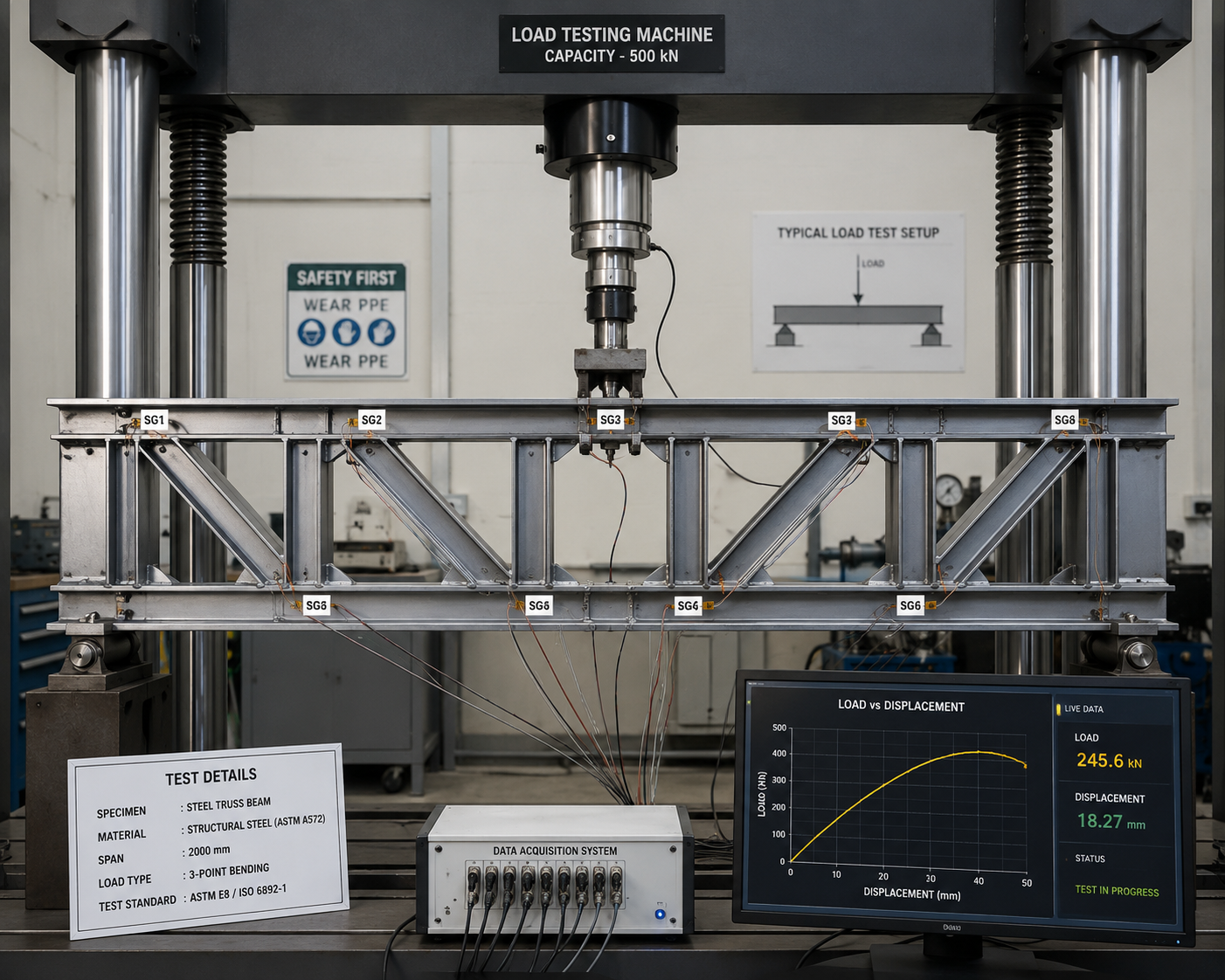
Strain gauges may be used where local structural response must be measured.
This method can support engineering validation, particularly where direct estimation of structural stress is required.
Engineering Calculation
Engineering calculations may assess:
- Structural members
- Welds
- Bolts
- Pins
- Padeyes
- Foundations
- Connections
- Lifting beams
- Crane runways
- Support frames
The calculation must use verified dimensions, materials, boundary conditions and load cases.
Finite Element Analysis
Finite element analysis may be appropriate for complex geometry, unusual load paths or local stress behaviour.
Nevertheless, an accurate model depends on accurate field information.
Incorrect support conditions, material assumptions or load positions can produce misleading results.
Non-Destructive Testing
NDT does not replace load testing.
Instead, it provides additional information about material condition and defects.
Depending on the component, applicable methods may include:
- Visual testing
- Magnetic particle testing
- Dye penetrant testing
- Ultrasonic testing
- Ultrasonic thickness measurement
NDT may be performed before or after the load test.
Acceptance Criteria and Test Loads
The correct test load depends on the equipment and governing requirements.
It may be based on:
- Manufacturer instructions
- Applicable legislation
- Equipment-specific standards
- Original design requirements
- Approved engineering calculations
- Client specifications
- Repair documentation
- Modification documentation
- Commissioning procedures
For example, OSHA’s overhead and gantry crane provision states that the test load must not exceed 125% of rated load unless the manufacturer recommends otherwise. However, that requirement applies within the scope of the specific provision. It should not be copied automatically to every crane, lifting accessory or structure.
Accordingly, TechInspecta does not apply one universal percentage to every asset.
We define the test load after confirming:
- Equipment type
- Manufacturer requirements
- Design basis
- Intended capacity
- Applicable standard
- Test configuration
- Structural condition
Acceptance criteria may include:
- Ability to sustain the target load
- Stable operation
- Satisfactory brake holding
- No abnormal sound
- No uncontrolled movement
- No unacceptable leakage
- Deflection within the specified limit
- No unacceptable permanent deformation
- No new cracks
- No connection damage
- Correct operation of safety devices
- Satisfactory condition after unloading
A report or certificate is valid only for the identified asset, tested configuration, stated capacity and date.
It should not be used to justify:
- A higher capacity
- A different operating radius
- A modified arrangement
- A different support condition
- An unrelated load case
When This Inspection Is Required
Our approach helps clients identify structural weaknesses, confirm safe working limits, evaluate the impact of corrosion or damage, and make informed decisions about continued operation, repair, strengthening or load restrictions. This service is essential for ageing infrastructure, post-incident assessment, equipment upgrades and safe port asset management.
Applicable Standards and Technical References
The technical framework is selected according to the asset, client contract and applicable legal requirements.
References may include:
- ISO 9927-1:2013, Cranes — Inspections — Part 1: General
- ISO 9927-5:2017, Cranes — Inspections — Part 5: Bridge and gantry cranes
- ISO 4309:2017, Cranes — Wire ropes — Care and maintenance, inspection and discard
- ISO 12482:2014, Cranes — Monitoring for crane design working period
- ISO 23814:2024, Cranes — Competency requirements for crane inspectors
- ISO 12480-1:2024, Cranes — Safe use — Part 1: General
- ASME B30.2, Overhead and Gantry Cranes
- ASME B30.5, Mobile and Locomotive Cranes
- ASME B30.20, Below-the-Hook Lifting Devices
- ASME BTH-1, Design of Below-the-Hook Lifting Devices
- ISO 13822:2010, Assessment of Existing Structures
- Applicable Eurocodes
- Applicable British Standards
- Manufacturer specifications
- Client engineering standards
- Applicable Mozambican requirements
ISO 9927-1 establishes general requirements for crane inspections, while ISO 9927-5 provides requirements for bridge and gantry crane inspections. ISO 4309 addresses the care, maintenance, inspection and discard of steel wire ropes used on cranes and hoists.
ISO 12482 provides a method for monitoring the actual duty of a crane against its original design duty. In addition, ISO 13822 provides general procedures for assessing existing buildings, bridges and industrial structures.
ASME B30.2 covers specified overhead and gantry cranes, including their construction, installation, operation, inspection and maintenance. ASME B30.5 addresses mobile and locomotive cranes, including inspection and testing requirements.
ASME B30.20 addresses the marking, construction, inspection, testing, maintenance and operation of below-the-hook devices. ASME BTH-1 provides related structural and mechanical design criteria.
Where independent inspection-body or laboratory controls are contractually required, the client should confirm the required accreditation scope.
ISO/IEC 17020:2026 addresses the competence, impartiality and consistent operation of inspection bodies. ISO/IEC 17025:2017 addresses competent testing and calibration laboratories.
TechInspecta defines each deliverable honestly. A report will not be described as accredited unless the activity is covered by a valid accreditation scope.
What You Receive
The final deliverables depend on the agreed scope.
A typical load testing and certification Mozambique package may include:
- Test procedure
- Risk assessment
- Method statement
- Pre-test inspection checklist
- Equipment identification record
- Calibration information
- Test-load verification
- Loading sequence
- Measurement results
- Photographic evidence
- Operational observations
- Post-test findings
- Non-conformity list
- Engineering assessment
- Load-test report
- Test certificate or statement of result
- Recommendations
- Limitations
- Follow-up actions
The report distinguishes between:
- Confirmed facts
- Measured values
- Client-provided information
- Engineering assumptions
- Limitations
- Recommendations
This distinction improves transparency and reduces the risk of misinterpretation.
Benefits of an Integrated Inspection and Engineering Approach
One Coordinated Technical Scope
A load test may require lifting inspection, structural inspection, NDT, measurement and engineering calculation.
Coordinating these activities under one scope reduces gaps between contractors and disciplines.
Safer Test Planning
The test is planned around the asset and site conditions.
As a result, the team can identify unsuitable reaction points, weak supports, poor access or missing documentation before applying the load.
Defined Acceptance Criteria
A test is meaningful only when its acceptance criteria are established before testing.
Therefore, we identify the manufacturer requirement, standard, calculation or client specification that supports the final decision.
Traceable Results
Instrument identification, calibration information, photographs, readings and equipment configuration are recorded.
Consequently, clients receive evidence that supports audits, handover and maintenance decisions.
Practical Recommendations
When an asset does not meet the criteria, the report explains the recommended next step.
This may include:
- Repair
- Component replacement
- Derating
- Restricted use
- Additional NDT
- Engineering calculation
- Structural strengthening
- Removal from service
- Retesting
Why Choose TechInspecta Integrity Services, Lda.?
TechInspecta is a Mozambique-based engineering inspection company focused on industrial safety, technical compliance and asset integrity.
We understand that clients need responsive service. However, they also need technically defensible findings.
Clients choose TechInspecta because we provide:
- An integrated inspection and engineering approach
- Risk-based test planning
- Clear scope definition
- Support for cranes and lifting equipment
- Support for industrial structures
- Access to complementary NDT methods
- Practical technical reporting
- Transparent assumptions
- Clear limitations
- Local mobilisation support
- Commercially focused communication
- Evidence-based conclusions
We do not treat load testing as a ceremonial exercise.
Instead, we consider the complete load path, actual asset condition, intended operating duty and applicable technical requirements.
Planning commissioning, repair verification or a critical lifting operation? Contact TechInspecta for a tailored load-testing and structural-assessment proposal.
Structural Inspection Mozambique Support
Physical load testing is not always the first step.
Where deterioration, damage or an unknown modification exists, structural inspection Mozambique services may be required before any load is applied.
The inspection can include:
- Visual condition assessment
- Dimensional survey
- Corrosion mapping
- Ultrasonic thickness measurement
- Weld inspection
- Bolt inspection
- Connection checks
- Crack detection
- Foundation review
- Support-condition review
- Modification assessment
- Identification of missing members
- Material verification
- Coating-condition assessment
- Drainage assessment
The findings help determine whether testing can proceed safely.
They also improve the accuracy of any engineering calculation or structural model.
Structural Integrity Assessment Mozambique for Existing Assets
Existing structures may have incomplete or unreliable design information.
In that situation, our structural integrity assessment Mozambique approach can combine field measurements with engineering analysis.
The process may include:
- Defining the required service load.
- Identifying the structural system.
- Confirming the load path.
- Measuring structural members.
- Recording connection details.
- Estimating or verifying material properties.
- Measuring corrosion loss.
- Recording damage and deformation.
- Developing representative load cases.
- Checking structural strength.
- Checking stability.
- Checking serviceability.
- Assessing repeated-load or fatigue concerns.
- Recommending repairs or restrictions.
- Determining whether physical testing is justified.
This approach is particularly useful for:
- Legacy platforms
- Modified structures
- Old lifting beams
- Crane runways
- Custom lifting devices
- Imported equipment
- Structures with incomplete records
- Corroded industrial assets
Service Coverage Across Mozambique
TechInspecta can plan mobilisation for industrial and infrastructure sites across Mozambique, subject to access, project scope and scheduling.
Potential service areas include:
- Maputo
- Matola
- Boane
- Beira
- Chimoio
- Tete
- Nacala
- Nampula
- Pemba
- Palma
- Afungi
- Surrounding industrial and project locations
For remote sites, early planning can reduce mobilisation cost.
Therefore, clients should share the asset list, location, required date and available technical records during the initial enquiry.
Information Required for a Quotation
To prepare an accurate proposal for load testing services Mozambique, please provide:
- Equipment or structure type
- Manufacturer
- Model
- Serial number
- Asset number
- Rated capacity
- Proposed service load
- Site location
- Required date
- Reason for testing
- Drawings
- Manufacturer manuals
- Previous inspection reports
- Previous test reports
- Repair information
- Modification details
- Client standard
- Required certificate format
- Available test weights
- Water availability
- Site-access requirements
- Induction requirements
Photographs are also useful.
In addition, a short video can help clarify access, equipment configuration and surrounding hazards.
Send your asset list and project location to TechInspecta. Our team will define a safe and efficient verification scope.
When This Inspection Is Required
Load testing and capacity verification may be required in several situations:
- Before Increasing Operational Loads - If the client wants to introduce heavier cranes, larger trucks, bigger forklifts, reach stackers, heavier containers or new cargo-handling equipment, the structure must be checked to confirm that it can safely support the new load demand.
- After Structural Damage - After vessel impact, accidental overloading, fire, storm damage, collision, excessive vibration or visible deformation, the structure may require verification before it is returned to service.
- For Ageing Port Infrastructure - Many port structures operate for decades in aggressive marine environments. Salt water, humidity, chloride attack and corrosion can reduce the load-bearing capacity of steel and reinforced concrete structures over time.
- When Drawings or Design Records Are Missing - In many existing facilities, original design drawings, material specifications or construction records may be incomplete or unavailable. In such cases, field inspection, testing and engineering assessment are necessary to estimate the actual structural capacity.
- When Drawings or Design Records Are Missing - In many existing facilities, original design drawings, material specifications or construction records may be incomplete or unavailable. In such cases, field inspection, testing and engineering assessment are necessary to estimate the actual structural capacity.
- As Part of Asset Integrity Management - Regular capacity verification supports safe asset management by identifying structures that can remain in service, structures that need repair and structures that require load restrictions or strengthening.
Frequently Asked Questions
Load testing is the controlled application of a known load to equipment or a structure. It checks performance against defined acceptance criteria.
The test may evaluate holding capacity, operation, deflection, stability or structural behaviour.
Proof load testing applies a specified test load to an asset according to an applicable standard, manufacturer instruction, procedure or engineering requirement.
It provides evidence for the tested configuration. However, it does not justify loads outside that configuration.
No.
Some standards or regulations use 125% for specific crane types and conditions. However, the correct test load must be confirmed from the manufacturer, applicable standard, legislation, approved procedure or engineering assessment.
Using a universal percentage can be unsafe.
Yes.
TechInspecta can support crane load testing Mozambique projects for suitable overhead, gantry, jib, mobile and other crane systems, subject to technical review, site conditions and an approved test procedure.
Typical assets include:
- Cranes
- Hoists
- Chain blocks
- Lifting beams
- Spreader beams
- Lifting frames
- Winches
- Davits
- Monorails
- Padeyes
- Lifting points
- Below-the-hook devices
No.
Inspection examines condition, defects and compliance. Load testing applies a controlled load and observes performance.
Usually, an inspection should be completed before and after the test.
The test should be stopped or controlled according to the approved procedure.
The asset should remain out of service or under formal restriction until the cause has been assessed.
Further action may include repair, NDT, calculation, component replacement, derating or retesting.
Where appropriate, TechInspecta can issue a test certificate or statement of result within the agreed scope.
The document identifies the asset, tested capacity, configuration, date, method, criteria and limitations.
Accreditation claims are made only when supported by a valid accreditation scope.
The duration depends on:
- Asset type
- Capacity
- Site access
- Test method
- Number of items
- Available documentation
- Test-weight availability
- Engineering requirements
A prepared individual item may be tested quickly. However, a crane or structural-capacity project may require several stages.
Yes, subject to technical feasibility, safe access, approved planning and availability of the required test arrangement.
On-site testing may reduce equipment transport and operational disruption.
Potentially.
However, a load test alone may not be sufficient. The beam may require dimensional verification, material identification, weld inspection, NDT and engineering calculation before a safe test is approved.
There is no single interval for every asset.
The frequency depends on legislation, manufacturer guidance, applicable standards, operating duty, equipment condition, repairs, modifications and client requirements.
A competent person should determine the appropriate interval.